
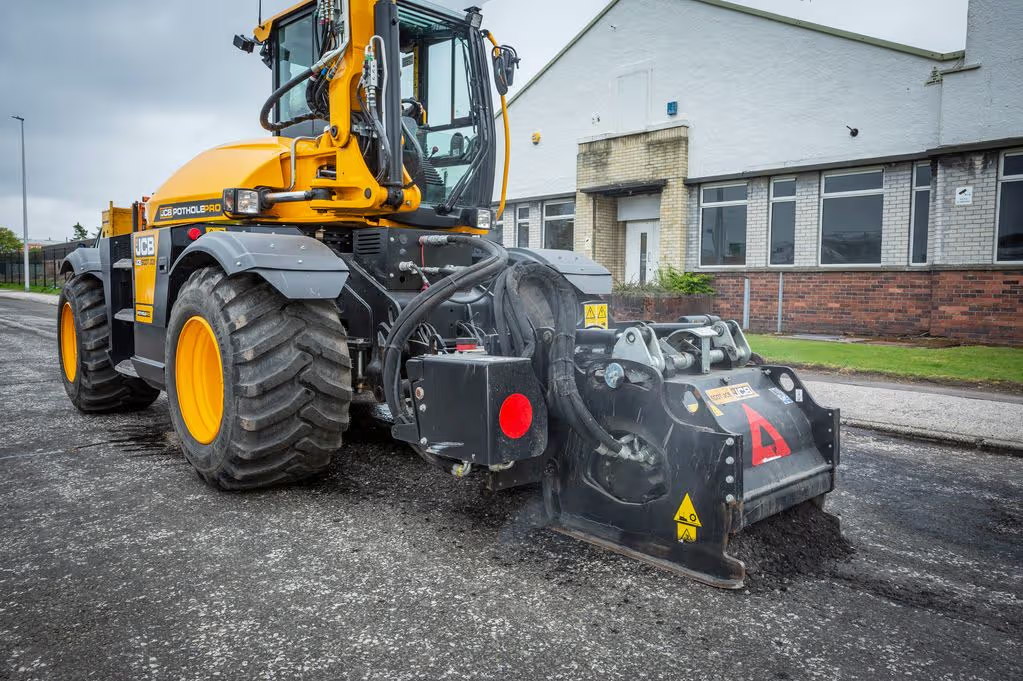
Coventry’s PotholePro has no programme KPIs — so can the council prove its value?
Status: Findings published — business case, cost and durability records being pursued
Coventry bought a JCB PotholePro in 2022 to speed up road repairs. Council FOI839035386 says the programme has no specific KPIs, no individual repair-duration data and no precise repeat-defect record. The council also reports substantial output. The unresolved question is whether activity can be converted into evidence of value and durability.
The Coventry impact
A pothole is a daily test of local government. Drivers feel it through damaged tyres and suspension; cyclists face a safety risk; residents see a repaired surface and expect it to last. A specialist machine matters only if it improves that experience consistently.
What we found
Coventry began using one JCB PotholePro in February 2022 after a 2021 trial. Contemporary public reporting put the machine’s price at roughly £165,000, while the council’s capital programme rounded the purchase allocation to £0.2 million.
The original promise was speed and productivity. The council said the trial repaired more than 100 square metres in two hours, compared with four days using its traditional approach, and described the machine as a way to reduce the defect backlog rather than deliver a cashable saving.
There is evidence of output. A March 2024 council highways report said the PotholePro team completed about 100 square metres of carriageway defects a day and had repaired more than 45,000 square metres since February 2022.
There is also a clear measurement gap. In its response to FOI839035386, dated 11 June 2026, the council answered “None” when asked for KPIs, targets or performance indicators used to assess the PotholePro programme.
The same response said it did not hold individual repair-duration information. It also said defect locations were not precise enough to identify how often the exact same defect had been repaired more than once. Several jobs on one road therefore cannot be used as proof that one pothole repeatedly failed.
The council has since reported a green rating under the national highways-maintenance transparency system and describes the PotholePro as one part of broader planned maintenance. That positive context belongs in the account, but the national rating does not isolate the machine’s contribution.
Why it matters
Residents do not experience “square metres completed” in isolation. They experience safer roads, less disruption and repairs that remain intact. Output matters, but outcome matters more.
The frustration is that Coventry made strong public claims about speed and permanence yet did not create specific programme KPIs capable of testing them over time. That leaves good work by road crews harder to demonstrate and poor performance harder to correct.
What the evidence does and does not show
The evidence does not show that the PotholePro failed. On the contrary, the council has published substantial output and says the machine delivers high-quality, long-lasting planned repairs.
It also does not establish the current article’s road-level activity totals as repeat failures. A road can contain many separate defects, and work may have been completed by different teams or methods.
What the evidence shows is narrower: the council cannot currently report machine-specific targets, individual repair durations or exact repeat-defect rates from its central records. Output alone cannot demonstrate cost per repair or durability.
The unanswered questions
The council holds the original approval and business case, the purchase and financing record, and the deployment and operating data. Those documents can establish what success meant when the machine was bought.
The next account also needs staffing, transport, fuel, maintenance and downtime; work locations and square metres completed; the backlog trend; inspection standards; and a comparison with other repair methods.
Durability requires precise location identifiers and follow-up inspection. Without them, a 12- or 24-month survival rate cannot be calculated reliably.
Our verdict
Coventry can point to real output from the PotholePro, and that deserves credit. But buying specialist equipment without specific programme KPIs is weak management. The council’s own promise was faster, more effective repair. The missing proof is the cost, backlog effect and durability achieved, not only the area treated. Road crews deserve a system that proves their results; taxpayers deserve the same proof before further investment.
What we are doing about it
We have obtained and reviewed FOI839035386 and compared it with the council’s 2022 promise, March 2024 highways report and 2025/26 highways transparency report.
The next request will seek the original business case, confirmed purchase and whole-life cost, deployment records, operating costs, downtime, backlog series and any inspection data capable of comparing PotholePro repairs with other methods. We will not infer repeat failure from road-level job counts.
Evidence and status
Status: Findings published; follow-up evidence request planned.
Last updated: 6 August 2026.
Primary sources: Coventry FOI839035386, 11 June 2026; March 2024 Highways Asset Management report; One Coventry performance report 2021/22; 2025/26 local highways maintenance transparency report; council report of a green highway-maintenance rating.
FOI reference: FOI839035386.
Next expected evidence: Follow-up filing and deadline to be published; no date is yet known.